Independent guide
World of Warships: What It Is, How It Plays and Whether It Suits You
World of Warships is a free-to-play online naval action game in which two teams of players command warships from roughly the first half of the twentieth century. This guide explains how battles actually work, what the ship classes do, how progression and spending work, and what a new player should know before downloading it. We describe the game as it is; we do not promise that you will enjoy it or be good at it.
Key facts
| Developer and publisher | Wargaming |
|---|---|
| First released on PC | 2015 |
| Business model | Free to download and play; optional purchases (premium ships, premium account time, the premium currency “doubloons”, bundles and randomised containers) |
| Platforms | Windows PC (via Wargaming Game Center or Steam). Consoles and mobile devices get separate games: World of Warships: Legends (PlayStation, Xbox) and World of Warships: Blitz (mobile). |
| Ship classes | Destroyers, cruisers, battleships, aircraft carriers and submarines |
| Typical team size | Up to 12 players per team in Random Battles; smaller in some modes and at low tiers |
| Internet connection | Required — the game is online only |
What the game is
In World of Warships you command a single ship in each battle. You steer it, choose where to aim its guns, torpedoes or aircraft, and decide when to use a limited set of consumables such as smoke screens or repair systems. Your team wins by working together towards an objective rather than by one player doing everything.
The ships are modelled on vessels from roughly the early 1900s to the 1950s. Alongside ships that were really built, the roster includes designs that only existed on paper and some that are largely the developer's own interpretation. It is therefore not a history lesson, even though many ships carry historical names.
The game sits between an arcade shooter and a simulator. Shell travel time, armour thickness and the angle at which a shell strikes a ship all matter, but the physics are simplified and the controls are designed to be learned in a few battles. Depth comes from positioning, map knowledge and teamwork rather than from complicated controls.
Partner link: we may earn a commission if you register through it. It costs you nothing extra. The game itself is free to download and offers optional in-game purchases.
How a battle works
Most players spend most of their time in Random Battles: you choose a ship you own, press “Battle!”, and the matchmaker builds two teams from players in the queue with ships of similar tier. Battles typically last up to 20 minutes. A team wins by destroying every enemy ship, by reaching the points target through the mode's objective, or by being ahead on points when time runs out.
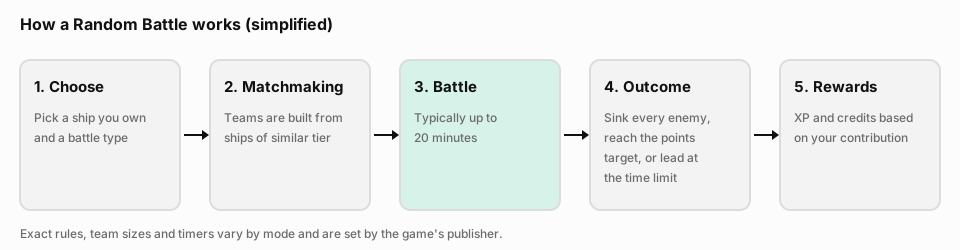
After the battle, you receive experience (XP) and credits. How much depends on what you contributed — damage dealt, ships spotted, points captured and so on — and on whether your team won. Sinking early does not end your session: you can leave that battle and start another in a different ship while the first one finishes.
Battle objectives and modes
Random Battles rotate between several objective types. The three that have been used most are shown below; which of them appear, and on which maps, has changed from update to update.
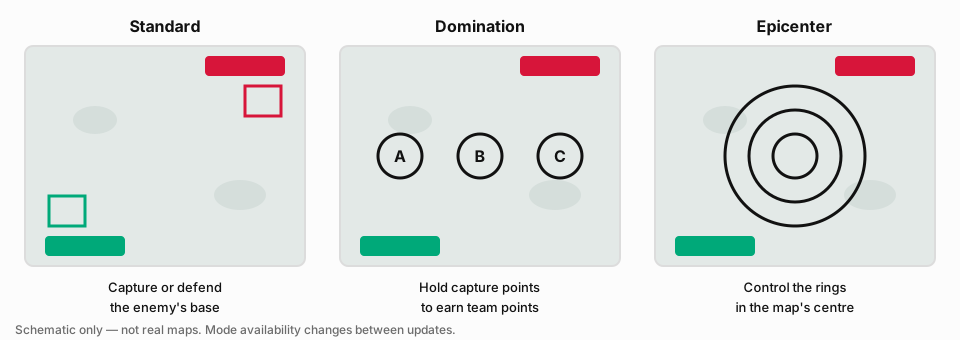
- Standard — each team has a base; capturing the enemy's base is one way to win.
- Domination — several capture points generate points for the team holding them; sinking enemies also shifts the score.
- Epicenter — concentric rings in the middle of the map act as capture zones.
Beyond Random Battles, the game offers Co-op Battles against computer-controlled ships (a low-pressure place to learn), Operations (scripted scenarios against bots), Ranked Battles in seasons, Clan Battles for organised teams, and time-limited event modes. Availability and rules vary by season, so check the in-game schedule.
The ship classes
Each class plays very differently, and a team works best with a mix. The descriptions below are general: individual ships can deviate a lot from their class's typical profile. For more detail, read our ship classes guide.
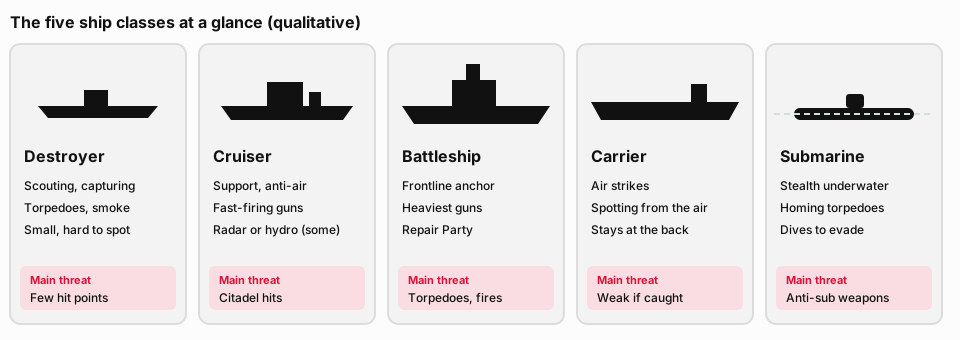
- Destroyers are small, fast and hard to detect. They scout, contest capture points and threaten larger ships with torpedoes, but have few hit points.
- Cruisers are versatile support ships with fast-firing guns. Many can defend against aircraft, and some carry detection consumables such as radar or hydroacoustic search. Many have vulnerable citadels.
- Battleships carry the heaviest guns and armour and usually have a Repair Party consumable to recover lost hit points. They are slow to turn and vulnerable to torpedoes and fires.
- Aircraft carriers stay far from the fighting and control squadrons of aircraft that attack, and that also spot enemies for the team.
- Submarines were added in later updates. They can dive to avoid detection and fire torpedoes, some of which home in on targets; other classes counter them with anti-submarine weapons.
Core mechanics worth understanding
Detection and spotting
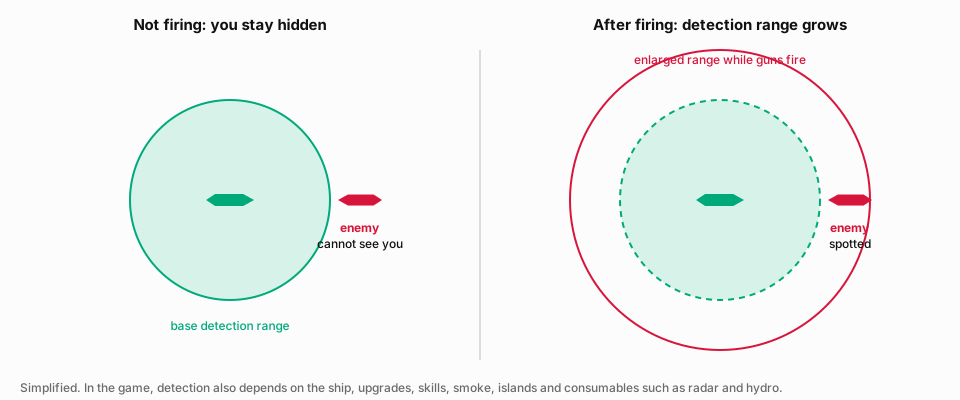
You can only shoot at what your team can see. Every ship has a detection range: if an enemy comes within it, your ship is revealed to their whole team. Firing your main guns temporarily increases the distance from which you can be seen, so a ship that was hidden becomes visible as soon as it opens fire. Islands block line of sight, smoke screens hide ships inside them, and consumables such as radar and hydroacoustic search reveal ships that would otherwise stay hidden.
Armour, angles and shell types
Armour-piercing (AP) shells do their best damage when they penetrate a ship's armour and explode inside it — above all in the citadel, the protected area around engines and magazines. High-explosive (HE) shells do less damage per hit against heavy armour, but can damage lightly armoured areas and start fires. Some nations also use semi-armour-piercing (SAP) shells.
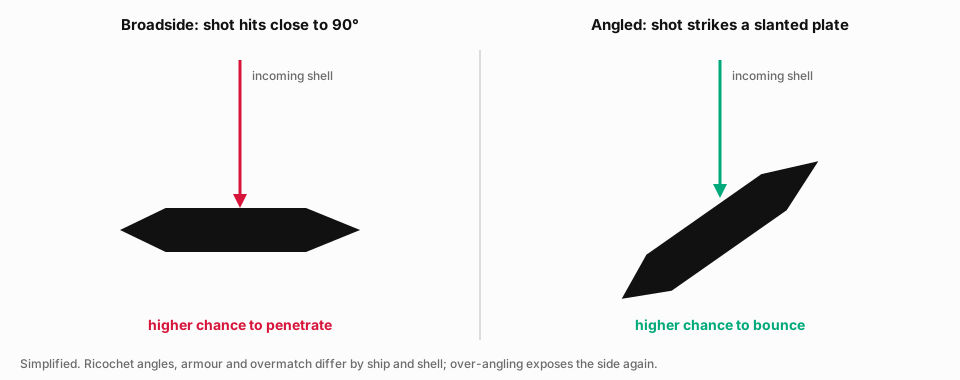
The angle at which a shell strikes matters. A shell hitting armour nearly at a right angle is more likely to penetrate; a shell striking at a steep slant is more likely to ricochet or break up. Turning your ship so that incoming fire hits your armour at a slant (“angling”) therefore reduces damage. However, turning too far exposes your side again. Community documentation also describes an overmatch rule, under which a sufficiently large shell ignores angles on thin plating. The exact thresholds depend on shell and ship and have been adjusted over time, so we do not quote precise figures here.
Fires, flooding and repairs
Hits can set a ship on fire, and torpedoes can cause flooding. Both drain hit points over time until they are put out, burn out or are repaired. The Damage Control Party consumable ends these effects but then goes on cooldown, so timing it is a skill in itself.
Progression and money
Each nation has one or more tech trees of ships, arranged in tiers. You use XP earned on one ship to research the next, then buy it with credits. Tiers run from I to X, and the game has also added a small number of ships above tier X. Higher-tier ships usually cost more credits to keep in service, so many players move up gradually.
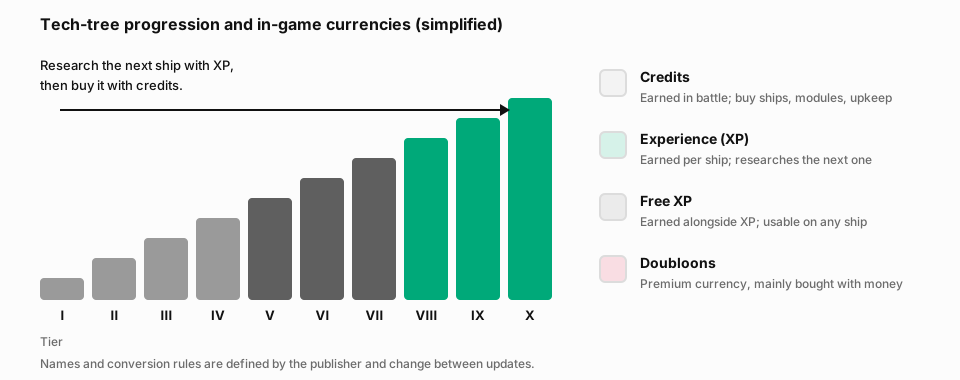
Money comes in through several optional purchases:
- Doubloons, the premium currency, mainly bought with real money.
- Premium ships, which cannot be researched. According to the publisher they are balanced against tech-tree ships of the same tier, but they typically earn more credits and so speed up progression.
- Premium account time, which increases the XP and credits you earn.
- Containers and some bundles with randomised contents. Their contents are random, which makes them similar to loot boxes. The publisher publishes drop rates; read them before you buy.
Whether this model counts as “pay-to-win” is genuinely debated among players. Spending does not buy skill, and you can reach the top tier without paying. But paying can shorten the grind, and some premium ships are considered stronger than others. We suggest deciding on a budget before you start and treating any spending as entertainment.
Strengths and drawbacks
Strengths
- Free to download and to progress through every tech tree
- Five classes that play very differently
- Controls that are simple to learn, with real tactical depth
- Co-op and scenario modes for learning without pressure
- Regular updates with new ships and events
Drawbacks
- Progress at higher tiers can be slow without spending
- Randomised containers and many offers can encourage impulse spending
- Battles can be decided by team coordination you do not control
- Frequent balance changes mean guides go out of date
- Online only; no cross-play between the PC game and the console game
Partner link: we may earn a commission if you register through it. It costs you nothing extra. The game itself is free to download and offers optional in-game purchases.
How it compares
If you are choosing between naval games, the main differences are platform and realism.
- World of Warships: Legends, by the same publisher, is a separate console game with its own progression, designed around a controller. Accounts and ships do not carry over from the PC game.
- World of Warships: Blitz is a separate mobile game with shorter battles.
- War Thunder, by a different developer, includes naval battles alongside air and ground combat and generally leans closer to simulation.
Which one suits you depends on your platform and on how much realism you want. We have not measured the size of each game's player base, so we make no claims about which is the most popular.
Tips for new players
- Start with cruisers or battleships at low tiers. They are generally more forgiving than destroyers, which depend on map awareness and careful use of stealth.
- Play Co-op Battles first. Bots are predictable, so you can learn how shells fly and how your ship handles without letting a team down.
- Do not sail in straight lines. Shells take several seconds to arrive; small changes of speed and course make you much harder to hit.
- Angle your armour, but do not over-angle. See the diagram above.
- Watch the minimap. Knowing where enemies are — and where your team is not — prevents most early sinkings.
- Do not rush to high tiers. Mistakes cost more there, and games are less forgiving. Many players advise learning a line thoroughly first.
Playing safely and responsibly
- Download the game only from the publisher's official site or an official store such as Steam.
- Protect your account with a strong, unique password and turn on two-factor authentication if your account settings offer it.
- Ignore offers of “free doubloons” or cheap accounts from third parties — they are a common way to steal accounts.
- Check the age rating on the store page, and use platform parental controls and spending limits for younger players.
Common questions
Is World of Warships free to play?
Yes. You can download it, play every standard mode and research every tech-tree ship without paying. Optional purchases can speed up progression or unlock premium ships.
Can I play with friends on console?
Not from the PC game. The console game, World of Warships: Legends, is separate, with its own accounts and progression. Check the publisher's site for Legends' current cross-play options between console families.
Do I need a powerful PC?
The game runs on a wide range of hardware, but requirements change with updates. Compare your computer with the minimum and recommended specifications on the official website before downloading. We do not reproduce them here because they change.
How long does it take to learn?
The controls take a few battles. Understanding detection, angling and map positions takes much longer, and many players keep learning for years. That is part of the appeal, but it also means your first battles can be frustrating.
Is it pay-to-win?
There is no single answer. Money cannot buy skill, and free players can reach the top tier. Paying does make progress faster and unlocks ships you cannot research. Decide for yourself after trying the free version.
Sources and method
This guide is based on the publisher's official information and on widely documented game mechanics. We checked facts against the sources below on the date shown at the top. Details such as modes, economy and balance change often. If anything here differs from the publisher's own information, the publisher's information prevails. If you spot an error, see how to request a correction in our editorial policy.
- Official World of Warships website and news/patch notes: worldofwarships.eu
- Official World of Warships wiki maintained by the publisher: wiki.wargaming.net
- Steam store page for World of Warships (platform availability and age rating): store.steampowered.com
- PEGI age-rating database: pegi.info
About the images: every illustration and diagram on this page was created by corivel.online as an original vector graphic. None of them is a screenshot or uses artwork from the game.
Trademark notice: World of Warships, World of Warships: Legends, World of Warships: Blitz and Wargaming are trademarks of Wargaming and/or its affiliates. War Thunder is a trademark of its respective owner. corivel.online is not affiliated with, endorsed by or sponsored by any of them.